Wednesday, April 23, 2008

Village People

Soon Heng Prawn Noodles
Alexandra Village Hawkers Center
#01-53

Somehow always in between haute cuisine, its always good to go back to our roots and enjoy something simple and familar in taste. With WGS and FHA on going simultaneously, a nights off from the socialising events meant I could have a break to enjoy local hawkers fare without much fuss.

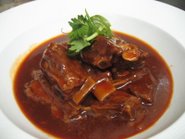
One of my recent discovery was the above mentioned stall that sells Singapore Style Prawn Mee Soup. While it is no where near in terms of quality comparison with the Penang version, still it is one of the better stalls that I have come across. Using my instinct to check out hawkers that are older and long standing only at a single location, this husband and wife managed stall prove that there are still some decent prawn noodles stall by local standards. I have had their noodles at different times of the day and best time is always after seven before nine in the evening when they close. The soup by now would be much richer and the pork ribs if u like, with meat falling off the bone tender. The broth is less darker but there is a nice pleasant balance of sweetness and savoury notes with a very meaty profile. Serve in aged porcelain bowls like what many of us used to know with push cart hawkers 20-30 years again, its nostalgic and I am always happy to find places that can offer memories of my childhood makan favourites again.

Btw, the Old Punggol Satay stall next to them is also very happening. I will do a short blog on them the next round when pics are ready.

Bocuse D'Or Singapore Selection

Despite being busy to the point of not being able to blog for the whole month, it has been a full month of good food experiences both eating out with N and key events happening in the local chefs industry.
The kick off started with Bocuse D’Or Singapore selection, a high profiled event in the global culinary world where representative competitors from 6 different continental zones meet in the finals at Lyons next year. The competition is held in honour to one of the world’s greatest chefs, Paul Bocuse. The Singapore winner will pitch his skills in the Asia region finals in Shanghai on May 30th with five others selected from countries within Asia. Only two competitors will be picked as representatives from Asia for the finals in Lyons 2009.
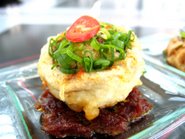
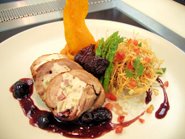
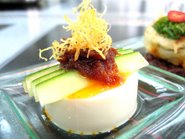
Our Singapore selection was held in the kitchens @ ITE Clementi on 15th of March. Some of the contestants include Executive Chefs Robin Ho (Marmalade Group), Edward Voon (The Cannery), Yong Bing Ngen (Majestic Restaurant), Executive Sous Chef Jeffery Siew (Merchant Court Hotel) and Sous Chef Jason Tan from Saint Julien Restaurant. The main sponsor of Bocuse D’Or is Norge who represents Norwegian seafood. Hence Norwegian Salmon was the main theme of the dishes and competitors had to cooked four main course portions from scratch within five hours. It is interesting to note that some dishes reflected the personality of the restaurants and chefs that work in them. Chef Edward Voon’s dish presented elements of molecular gastronomy with foams, gels and confit style cooking. Chef Robin showcased more on technical difficulty with alternate flavours and tastes while Chef Yong Bing Ngen stuck to his roots of interpreting Chinese classics with and modern European twist. In the end, both three won the selection and the winner was Chef Jason Tan from St Julien Restaurant.Though I wasn’t in the judging panel, I was still invited as guest to the event. Below are the other dishes that we sampled.

Sunday, March 23, 2008

Newspaper Article 14th March

The writer of this blog was featured in the billingual newspaper "My Paper" last week. As usual with local press, they will ask u for tonnes of information and then only publish half the story to their readers. I have it before already with Business Times and Sunday Life, now the one below is no surprise either:To my readers, here is the full story which u people will never see it published:

1. How were you being inducted as one of the omy bloggers?
Out of the blue one day two months before omy was launched, one of your colleagues got a referral about me from another referral, called me and the rest is history.
2. What is your exact occupation and where do you ply your craft?
I Cook, Host , Educate and Feed people about food professionally, ie CHEF. I started learning the craft since 16yrs old and never looked back since. I have done time in hotels, restaurants, catering, serving onboard super size megayachts and going with them around the world as well as undertaking personal chef disciplines of this profession. Currently I have spread my wings into research and development for the last five years incorporating the science of food and cooking with culinary art as a new portfolio. I practice this in the research facilities and kitchens of the world’s largest food, beverage and wellness company, N.
3. What are some of the goals you hope to achieve through your blog now that it's being read by the multitudes?
Realistically I hope to share more stories about my adventures with food and cuisines around the world as I travel regularly. Also to educate more people about how chefs look at food and the art of its appreciation from a culinary expert point of view. Well reading is not really enough, to understand things better, people also should come by to experience some of the global cuisine workshops that I conduct to introduce new ideas and ways of cooking from experiences (http://www.cookwithpassion.blogspot.com/).
Singaporeans eat to be seen but often more than half of the people I talk to have no idea what they are putting in their mouths and how things should be appreciated in the different cuisines as it is in their original culture. A good example is the appreciation of Spanish cuisine in Singapore. While many are hip and hop about celebrating Italian cuisine here because it is easy to start with pizza and pasta, but nobody can really say the same about Spanish food in Singapore. Both countries share the bounties of the Mediterranean Sea, have similar kind of cheeses, hams and vegetables as their cuisine repertoire and have a strong love for the taste of pork in different ways of preparation. But just look at how many Spanish restaurants are there in Singapore in comparison with Italian restaurants not to mention those that can be really called authentic. Pardon me, but if you can’t even find padron peppers here to start with as one of the most basic form of tapas, how far else can u go?

Unrealistically, I dream that all the people who read my blog will have the same enthusiasm about food in an educated way from media, dinning experiences and reference readings of various food related publications as I do and if that happens, the Chef profession will become the most respected occupation in Singapore. Right now I can’t even say if it has made it to top twenty yet. Singaporeans generally still prefer to be served than having to serve.

4. What is it about your blog do you think will attract layman readers who haven't got a clue about fine dining and quality cuisines?
Pictures. Along with the stories of the articles, every picture says a thousand words and is self explanatory when you look at them. Also, I try to explain the emotions, feelings evolved, and the right mindset of the dinning experiences in relation to the restaurant’s environment, chefs’ skills and the complexity of preparing such dishes in a stressful environment.

5. As a chef, what is your axiom when it comes to creating culinary delights?
Never serve food to people that you would not want to have for yourself.

6. We all know that you are an avid traveller through your blog, please tell us about a trip or two that you remember the best and what was about it that made it so memorable - the food, the people, the sights etc?
1) 1998 Atlantic Crossing. Working onboard a Monaco based super yacht, we had to cross the Atlantic Ocean to Fort Lauderdale in Florida for the annual boat show there. The trip took us across the Mediterranean Sea, encountering 7 foot waves around the Gulf of Lyon. We stop at Gibraltar for fuel and took shelter again in Tenerife, Spanish Canary Islands before making the pitch to cross the ocean. We were blessed with fantastic weather and tail currents pushing us as we cross the ocean for five an half days, reaching the US Virgin Islands of St Croix. Along the way, I saw dolphins trying to chase our yacht by swimming along side us and playing with the waves created by the propellers. I admired beautiful sunsets and sunrises over the horizon and no matter how big a boat looks in port, it’s just a tiny weenie dot on the vast ocean. There was peace in appreciating the calmness if the ocean at times and we also passed an entire US Navy Carrier Battle Group of aircraft carrier, frigates and destroyers. It was an awesome sight. In the nights, it was pitch dark on deck that you could not even see your own palm. But it was so beautiful looking at the stars on clear cloudless nights.
2) Atlantis Bahamas Integrated Resort
After the boat show in Florida, we move to Paradise Island in the Bahamas for three months when the Atlantis Integrated Resort first opened in 1999. It was the most happening place on earth then with the luxurious accommodations, casinos, a few fantastic underground aquariums and lots of food and beverage outlets to choose from. Though we did not stay in the resort rooms, we still use the facilities of the resort and full access to the attractions on it. It was a memorable three months of seeing and experiencing a brand new integrated resort way even before Singapore talked about building them.

7. What is the dish that has you wanting to go back for more all this while? Why?
Mum’s Braised Chicken Wings with Carrots and Potatoes. A simple home cooked dished of braised deep fried chicken wings with soy sauce, spices, carrots and potatoes, the wings were braised till it was almost falling off the bone the taste of it very balanced with a delcious balances in taste of savoury sweetness. I practically grew up with this dish from the day I could take rice as a toddler and thinking about it makes me salivate. It was especially memorable when I was away working in Europe and US and it’s a comfort food that makes me feel homesick sometimes.
8. If you meet a rat who can teach you how to cook a dish, what will it be?
Being born in the year of the Rat, it would be more interesting to go out and explore new dishes together.

9. Please pick a lesser known Singaporean dish that has a potential to be known internationally a la Chicken Rice, and why so?
Char Kway Teow. The best plate that I have eaten comes from the tuck-shop of the old St Anthony’s Boys School in Victoria Street. It was so good that the principal had to put a stop on members of the public from coming in to the school just to eat it. Char Kway Teow is a dish of Teochew origin. But it is found around South East Asia in many different forms. In Malaysia, Penang Char Kway Teow is the best in the country. In Thailand, Pad Thai is the Tha represented version while Cambodia, and Vietnam, Char Kway Teow is kept close to its roots as the way it’s done in Shantou China. The fried noodles are served white with slight variations of condiments like prawns and pickled radish that distinguishes them from one another. Interestingly, Singapore Char Kway Teow is fried with a sweet molasses flavoured dark soya sauce and cockles. It has been widely accepted by locals and integrated as part of our local food culture. It is being widely promoted by our tourism board as one of the icons of our local hawker dishes.

10. Many people think that preparing fine dining takes alot of time and effort. Is this true or just plain hearsay? What was the fastest time you took to create a palatable dish?
Fine dining recipes take skills and patience to prepare. Skills are required because of a greater technical difficulty. Patience is a must to combine the individually prepared components of a dish for example the marinating of meats, preparation of sauces and garnishes. Culinary Artistry is also required to assemble all these components into a dish. Actually it is easy to prepare these individual components but takes time to prepare them. It’s all about organizing your preparation work or misc-en-place as we call it in kitchen lingo and u can assemble a dish with cooking involved in 10-15 minutes. Many people do not understand that the high prices charged in fine dinning is to justify all these activities which they do not see as customers.

11. Lastly, please tell us if you would eat the things you cook or do you prefer to let others taste it instead?
It is imperative that all chefs must taste their creations before serving them to customers. We are professionals so we must take responsibilities to make sure food is good when served. We taste to make the dish is right. Customers and guests should have the pleasure of enjoying the whole dish and if they do, it’s the best compliment and satisfaction to any chef. Ironically, people who cook usually loose their appetite in the process and takes about two hours later before they feel hungry again. Till then we will see what is leftover in order to decide for ourselves whether or not to eat our own dishes.

Sunday, March 16, 2008

Do U Get the MSG?(Message)

As a chef, one of those things that irritates me the most when people freak out or cringe when they hear of MSG in cooking. Thanks to the media who always portray half the story of MSG in whatever articles that are published, more often than not the taste enhancer is given the bad publicity than good.
During my apprentice years, a Chinese Masterchef once told me literally "no MSG, no Masterchef". His words speak of wisdom in understanding the skill of using MSG through natural occuring ingredients or as an add on ingredient during cooking process for that taste enhancement effect of the whole dish. I emphasize strongly on the word "Taste Enhancement" because there is a need to clear the air about using MSG for the above purpose and having it as a flavour substitute. To a certain extent, chefs and cooks are also responsible for the bad publicity of MSG due to a lack of knowledge in dealing with the use of this ingredient.First of all, lets look at some facts about MSG:

1) It is not a food poison. US FDA and our AVA approves of its use as a food ingredient
2) It is flavourless and has no aroma
3) Like salt, sugar and fats (oil), anything in excess is not good for your body. So is MSG
4) It has a lower level of sodium that salt

Different people have different tresholds for all kinds of taste, from salty to sweet, sour, bitter, spicy and umami. Can i blame chili as a bad ingredient if I am the kind of person that perspires profusely when my tastebuds are exposed to very spicy cuisine?
A good chef should know the art of creating the balance of taste in culinary artistry. The glutamate properties of MSG in naturally occuring ingredients or powder are able to effect the cause of salivation or mouth watering sensation when we eat such foods. For instance, if u bite into a sun ripen tomato, do u feel the urge to take a second bite because of flavour satisfaction? This urge is caused by the high natural occurence of MSG in tomatoes and in fact they are one the known vegetables with natural high content of MSG. Many chefs and hawkers try to cut corners for profit and laziness reasons. They think that if a little goes a long way, then the more the merrier which results in negative taste perceptions of this taste enhancement ingredient. Like salt and sugar, MSG does have a "saturation" point on our taste buds. Too much of it will cause our salivary glands to secrete excessive saliva thats results us to the point of feeling thirsty, hence the often mentioned Chinese Restaurant Syndrome. Good quality ingredients should form the basis of all dishes from the stocks and sauces used. A small dosage of MSG provides the dish with the essential amount of glutamates to the point of tickling our tastebuds with a gentle perception of savouriness and mouth watering effects. That is the proper way of using MSG in cooking so that it does not exceeds the excessive amounts that turns it into a negative effect on the palate. Sadly, many chefs/hawkers have yet to understand this fact or just cannot afford to have real quality ingredients in their recipes because of cost constraints caused by other fixed costs of operations like high rentals and labour wages. For example, u are more likely to get a lousy soup stock in mall operated food courts than in a neighbourhood hawkers center due the the difference of rentals that can be as much as a few thousand dollars a month. Below is an extract of a better understanding of the fifth taste Umami and more information of MSG not commonly published in main media.
Umami: The fifth taste
By Julie Cabatit-Alegre
Thursday, February 21, 2008
If it’s not sweet or sour or bitter or salty, what else could it be? Have you heard of umami? It is believed to be the fifth primary element of taste, in addition to the four basic tastes that we were taught in grade school and are familiar with.
A “new taste sensation” is how The Wall Street Journal described it. It is a “universal taste,” says Kumiko Ninomiya, director of the Umami Information Center in Tokyo, Japan. Ninomiya was the guest speaker at the first Umami Symposium in Manila held recently at the Blue Leaf Pavilion in Fort Bonifacio.
The “new taste sensation” was, in fact, identified 100 years ago by Prof. Kikunae Ikeda at the Tokyo Imperial University from experiments he conducted in 1907. He lived for two years in Germany where there were no Japanese restaurants, and it was then he felt the longing for that distinctive taste found in Japanese food.
In his experiments, Ikeda found the distinctive taste present in broth made from kombu, a type of dried seaweed found in traditional Japanese cuisine. From the kombu broth, Ikeda succeeded in extracting crystals of glutamic acid or glutamate, an amino acid, which is the building block of protein. He found that glutamate had a distinctive taste, which was different from sweet, sour, bitter, and salty. He called it umami, the Japanese term for deliciousness.
“But umami is not the same as deliciousness, although umami is part of deliciousness,” Ninomiya explains. The tasting sessions at the symposium resulted in a lively exchange among the participants, mostly food scientists and nutritionists, university professors and researchers, as well as chefs and foodies on what exactly is umami. The participants tasted dashi, which was prepared by a Japanese chef. Dashi is a clear broth, which is essential in Japanese cooking. It uses kombu as well as dried flakes from bonito, a naturally salty-tasting deep-water type of fish. Earlier, upon entering the symposium venue, the participants also took part in a taste test where they were made to sample two small bowls of tinola soup, and rate each one according to a set of questions provided. One of the bowls was umami.
The “um” factor is how culinary specialist Nancy Reyes, of the family of the iconic Aristocrat Restaurant, referred to it in her talk. “It is found all over the Filipino menu,” she says, “in adobo, sinigang, sisig, nilaga, and, of course, tinola.”
Condiments and dipping sauces are indispensable on a Filipino table, Nancy observes, and our own fish sauce or patis has been called “umami in a bottle.” Tomato is the most common ingredient used for umami. Nancy recalled how her grandmother, the venerable Aling Asyang, used to deputize her grandchildren to pick through large baskets of ripe tomatoes, choosing the ones at the peak of ripeness to be used in ginisa or the Spanish sofrito for sautéeing meat or vegetable with garlic, onion, and tomatoes in oil. “The overripe tomatoes are even more flavorful. They require shorter cooking time for the glutamates to be released,” Nancy explains.
“Adobo tastes better a day after it is cooked, when the glutamate is released and you get a rounded flavor that is umami,” she adds.
To enhance umami in cooking, Nancy shares the following techniques: Use heat to release the glutamate; through fermentation to produce glutamate acid (e.g. buro); add acids and pickle solution (i.e. sugar, vinegar); add onion, coconut milk and tomatoes; add MSG (monosodium glutamate).
MSG is said to be one of the most extensively researched food substances. On the question of safety when used as a flavor enhancer, Dr. Josefa Eusebio, president of the Philippine Glutamate Association and professor at UP-Los Baños, has this to say: “The body does not distinguish the source of glutamate, whether natural or manufactured. It is utilized by the cells in the small intestines. It is rapidly metabolized and 90 percent is used as energy. It does not accumulate in the blood stream. It is not toxic. There is no truth to the rumor that dogs die when burglars feed them MSG.”
Glutamate is found in mother’s milk, 10 times more than in cow’s milk. It is found in all protein-containing foods. Fermented foods are also rich in glutamate. In addition to glutamate, two other substances, which are important taste elements in natural foods — inosinate from dried bonito and guanylate from dried shiitake mushrooms — have also been identified.
Umami has been described as meaty or brothy. Parmesan cheese is said to be one of the most glutamate-rich foods, while mushrooms, particularly shiitake mushrooms, contain both glutamate and guanylate. Anything alive in the ocean is high in glutamate, and this includes seafood as well as sea plants, such as seaweed. The fermentation process in making fish sauce as well as soy sauce breaks down proteins, releasing flavorful glutamate.
The umami taste eliminates the need to use salt or oil and enables us to eat healthy. Our tongue acts as a barometer for taking in necessary nutrients. “You should try to be taste-conscious,” Ninomiya remarks. “Tasting is believing.”
Monosodium Glutamate (Extract from Food Product Design)
Many experts say that MSG should be looked at carefully assuming that its use is within the acceptable parameters. In other words, the designer must be sure its use is permissible with any label or marketing claims.
As with salt, MSG derived from naturally fermented sources has been used for centuries to improve the acceptance of Asian foods. In 1908, when extracting the glutamic acid salts from sea tangle, a type of seaweed, Kikunae Ikeda, Ph.D., called the flavor contribution "umami." Still under extensive study to elucidate the sensory mechanisms, it presents an interesting sensory, product development and public relations challenge. According to Franny Hildabrand, manager of technical services, technical products for Integrated Ingredients, Bartlesville, OK, it is the combination of taste and feeling factors that contribute to the gustatory experience. (For an extensive discussion, see Umami: a Basic Taste edited by Kawamura and Kate.)
MSG has been surrounded with negative publicity linking it with a number of adverse physical effects including headaches, dizziness and chest pain, popularized as the "Chinese Restaurant Syndrome." Because of the lack of scientific consensus on these effects, in 1995 the U.S. Food and Drug Administration (FDA) contracted the Life Sciences Research Office (LSRO) of the Federation of American Studies for Experimental Biology (FASEB) to analyze the safety issues related to the consumption of MSG and other food sources of glutamate based on the available scientific literature.
The Expert Panel convened by LSRO/FASEB concluded that the oral ingestion of more than 3 grams of monosodium glutamate in the absence of food can cause a sensitive subgroup of the general population to respond "generally within one hour of exposure, with manifestations of the MSG symptom complex" (their term for what has been called the "Chinese Restaurant Syndrome"). The report also indicated that certain asthmatics may experience bronchospasms, or difficulty breathing, after ingesting MSG in doses equal to or greater than 2.5 grams.
However, the Expert Panel also concluded that to date, no scientifically valid studies have been performed to confirm the existence of any of the hypothetical mechanisms that underlie adverse responses to MSG. They also stated that "no evidence exists to support the ability of orally ingested glutamate to produce neurotoxic or lesioning effects in humans." The panel could find no links to Alzheimer's or any other long-term or chronic disease. This has led the FDA to reaffirm that MSG and related substances should be considered safe ingredients "for most people when eaten at customary levels," according to an FDA position paper. FDA has also said that "we believe there is no connection between MSG and asthma."
Aileen Peters, vice president, public affairs, Ajinomoto USA, Teaneck, NJ, doesn't see the report as negative for MSG: "FDA concluded that MSG is safe for consumption for the general public. The FASEB report suggested further study because there was support for the concept that 3 grams on an empty stomach might cause some small portion of the population to have a reaction. The other question mark was a potential link between MSG and asthma Since that time the FDA has reviewed the data and come out very strongly saying they did not concur. The science on asthma is pretty conclusive."
Peters also notes that yet another study is underway at Scripps Clinic and Research Foundation, La Jolla, CA, that is expected to provide more evidence. She expects results of this study to be released in March.
Because the data indicate that some portion of the population may experience a reaction to MSG, the FDA has advanced notice of proposed rulemaking that may affect labeling requirements for foods containing free glutamates. It would require the labeling of foods containing more than 200 mg of glutamate per serving from any source. The reader is referred to the Federal Register, Vol. 61, No. 178, September 12, 1996 for more details. No final rules have been issued as of this writing.
Currently the FDA requires that when MSG is added to food, it must appear only in the ingredient legend. However, products labeled "no MSG" or "no added MSG" must not contain any ingredients that are considered sources of free glutamates such as hydrolyzed protein.
Peters notes that the industry is continuing consumer information programs "rather aggressively because the American public was not very well informed on what MSG was and why it was used. You avoid a problem by informing consumers in advance. You simply can't scare consumers if they know that the volume of science is behind MSG's safe use."
Monosodium glutamate is a powerful tool and, if within the agreed upon boundaries of acceptable solutions, should be considered a key test variable. However, if MSG can't be used to enhance flavor, what are the alternative choices? Product developers can turn to a variety of hydrolyzed vegetable proteins, yeast extracts, and 5' Prime nucleotides. However, the use of these ingredients may also be affected by consumer concerns regarding glutamates and FDA rulings on labeling.


Wednesday, March 05, 2008

City of Bohemian Crystal and Music

On a recent assignment to Prague, Czech Republic, representing the Singapore Chefs Association, I was lucky enough to be given an opportunity to meet the who’s who of the chefs profession in Continental Europe. I am not talking about the Michelin starred restaurant chefs who work in big fancy restaurants, but people who have made many sacrifices of the their private time and energy to proactively promote the chefs profession beyond their normal routines of work. For the less informed, in the world of the chef’s profession, there is supposedly at least one State government recognised chefs’ association or guild in every country all over the world. Each country is represented through their own chefs’ association in the mother of all chefs’ societies known globally as the World Association of Chefs’ Societies (WACS). Like the UN, WACS brings all the chefs around the world together in its activities and its representation is classified to different continents around the globe.
I was in Prague at the invitation of the current WACS Presidium with a fellow colleague as Team Singapore making our pitch for the Lion City’s bid to the running of the next presidium. One of the hardest thing things to adjust in business travel is jetlag where your body’s routine is upset by the different time zones. Still I would like to share everyone here pictures of the opening dinner prepared by the President of the Czech Republic’s Chef Association and his team of chefs for the 30+ of us in this conference representing more than 20 countries in Europe. Dinner was hosted at the Zlata Praha Restaurant, Hotel Intercontinental , Prague.

Here are some of the items on the Menu:
Starters:

Insalata Caprese,Cesear Salad with Chicken,Cobb Salad with 1000 Island Dressing
Italian Seafood Salad with Lemon Olive Oil Dressing

Main Courses:

Roast Pork Loin with Thyme Gravy, Confit of Lamb Shanks, Pilaf Rice, Buttered Vegetables, Oven Baked Fillet of Salmon on Green Pea Mash, Roasted Potatoes

From the dessert table of assorted pastries:

Btw did I mentioned that dinner ended@ 6am SG time for me......Yawn!


Wednesday, February 13, 2008

Rocking Good!

Wild Rocket @ Mount Emily
Hangout Hotel, 10a Upper Wilkie Road.
Singapore 228119.
Tel : 63399448
With the bulk of the festive cooking workshops finally over, N and I finally have sometime to catch a breather. We have missed one of our favourite weekend activities since last Oct due to the each other’s hectic schedule around this time of the year. We have read so many reviews of new restaurants launches in the past couple of months, some applauded, some trashed.
A firm believer to comment only on established restaurants, I seldom will want to write on a brand new establishment that is less than six months or a year old in order for them to sort out operation issues and fine tuning of menus. Hence when we could finally squeeze a Saturday evening out together, we chose to go to Chef Willin Low’s Wild Rocket @ Mount Emily which has been around for more than a year. It was our first experience but we have heard nothing but good raves about this place since its opening, both from media and friends. Stepping in after a nightmarish forty five minute jam, we still got our reserved table despite having an almost packed restaurant. A positive sign for the standard of food served is how I would perceive it as, considering the fickle minded of local customers here who seldom have loyalty to restaurants and are often spoilt for choices on where to go.
N started with a Seared Tuna on Rocket Leaves which came with soy and ginger flavoured dressing. Keeping things simple, the flavours were clean and the fish was fresh enough to stand on its own though it wasn’t the kind of sashimi yellow fin tuna. The rocket leave provided a nice cushion for the tuna and its peppery nutty taste encored the taste of the whole dish with great harmony.
I opted for something more comforting in the form of a Duck Consomme with Salted Vegetables and Duck Confit Ravioli. Basically this dish is also known locally as Kiam Chye Duck Soup in the heartlands. Chef Willin probably got the inspiration from there. The soup arrived with a meaty aroma that gave me a sensation of slow simmering for maximum flavour extraction. This was concurred by the taste profile which had rich meaty notes on the palate further enhanced by the innovative wonton skin raviolis filled with tender duck confit. The whole experience leads me to crave for a light red wine to go with the bowl of soup.
Before the main courses, we opted to share one of the Chef’s signatures which is a Laksa Pesto Linguine with Fresh Prawns. Initially visualizing it to be closer to our local hawkers’ version, it came with a direction closer to an Italian Pesto than a local one. Hence the sauce did not contain any notes of dried shrimp or coconut. The generous use of laksa leaves kept the associated colour of pesto and gave the sauce its signature aromatic fragrance. More importantly the chef got the texture of the pasta right at its al dente doneness. However the prawns could have fare slightly better for its freshness.
Being winter now in Europe, I urge N to go for the Boned Stuffed Quail with Prunes which turn out to be a great option. The bacon wrapped bird was roasted to the right doneness and went very well with the dried prune compote and gelatinous rich demi glace. Against the sweet prunes, each morsel of salty wrapped bacon quail tasted simply divine!
Hungry for carbohydrates, I opted for a Miso Braised Pork Soft Bone Risotto which was a deceivingly flat looking dish ready to explode with great flavours on the palate. The soft bones tasted more like tendons to me and their gelatinous nature enriched the dimension of complexity in this dish while complimenting the creaminess of the cooked rice grains. The miso pungency was well balanced into the overall taste of the dish and flakes of dried chilies gave it a spicy kick with the background of soft tender braised rib meat. I could relate this dish to a spicy version of Nonya Babi Pongteh and found its overall taste very comforting and homely with a subtle hint of sophistication.
Desserts found us having a Black Sesame Paste with Vanilla Ice Cream and a Kuay Bulu Tiramisu. The black sesame paste was not as smooth if its was to be compared to Cantonese Chee Ma Wu but the slight grittiness from caramel bits was a good contrast to the smooth velvety ice cream. What captivated me was the bulu tiramisu. In place of sponge fingers, were balls of coffee soaked kuay bulu interspersed with a marscapone cheese mousse flavoured with marsala wine. Yes! That's the important part of a good tiramisu in terms of authenticity. The other winning factor was the chef certainly does know the right way to serve a tiramisu.ie to have the sponge and mousse naturally portioned in a bowl and a generous dust of cocoa powder. It’s that simple but many chefs get it wrong by trying too hard with other liqueurs like Kahlua, Tia Maria or making it into a sponge cake, and worse still getting the mousse set with gelatin.
Overall the meal was enjoyable and the service was attentive but not intrusive and dose of occasional humour. We like this place and it has gone on my list of restaurants worth a return visit in the near future.

Wednesday, January 23, 2008

Berry Berry Good!!

Strawberries that look good, are horrendously crappy in taste
N and I are spoilt rotten for the taste of real good strawberries. For a fruit that is seen as a symbol of feministic attributes, happiness and childhood cartoon fantasies, it is a shame that good strawberries can be rarely be appreciated due to its highly perishable nature and delicate structure. More often than not, what we get in Singapore as an importing country are strawberries that look good but horrendously crappy in taste.
Crappy in the sense that despite the bright colours, it is unpleasantly sour to the extent that many Singaporeans have grown to thinking that strawberries are naturally sour despite the sweet images of it painted in cartoons and media fantasies. The truth is many Singaporeans have not really had the chance to experience what is really a good strawberry.
The ones from NZ, OZ & US...
The ones that we get all year round from New Zealand, Australia and US are of export quality which in real sense is not really the best. They have to be picked before reaching to a good maturity stage so that they have a longer shelf life in their final destinations. Thus the fruit does not have enough sunshine for the natural flavours and sugars to be fully developed to an ideal ripeness giving it the deserved sweetness and aromas as often associated with in ice creams, jams, fillings and essences.
Good strawberries?
Good strawberries are hard to come by in Singapore as we are not able to grown the fruit here due to the unfriendly weather.Malaysia has tried to cultivate them in Cameron Highlands but the project has seen hardly any other economic success other than being a novelty draw to regional tourists who are there only because of their children.

Now, we get Korean & Japanese ones...
Well the situation is not really that grim as the recent years of affluence have created a demand in taste for more premium strawberries. Hence now we get shipments of Korean strawberries around this time of the year till the end of May.
Occasionally the Japanese supermarkets like Meidiya and Isetan will also ship in Japanese strawberries when in season. The strawberries from these two countries can cost twice as much than those of from regular importing countries. But as a firm believer than cost and quality are more often than not co-related, U get a lot more in taste, sweetness and aromas with these premium berries that have been harvested at their prime, carefully packed and shipped out to their final destinations in the shortest time possible between the fields and dining table. These strawberries have a much more intense aroma when u sniff at them. On taste, they yield a higher level of sweetness complimented with mild acidity. Fantasise them served simply just with crème fraiche or vanilla sugar sweetened whipped cream, it can just send one on an orgasmic culinary experience with one of the greatest food marriages made in heaven!
Premium grade ones...
Besides the Korean and Japanese strawberries, another premium grade of strawberries that I have come across during my travels are the French strawberries, found only in the farmers markets of the cities and towns of historic villages. These berries are highly seasonal, available only in the short window period of late spring to mid summer before the weather gets too hot. They are distinguished from the mainstream commercially farmed strawberries in terms of being a size smaller, rounder and having their stalks still attached on just like the premium quality durians displayed in Geylang. They are sold more by weight and packed often by the vendors who will not allow u to touch or pick them due to their highly perishable nature.
Size does matter
In terms of taste, size does matter for strawberries and the intensity of each berry is co-related with its own size. The ultimate champions are the “frais du bois” or wild bush strawberries that grown in the forests of France with a size no bigger than that of an almond nut.
These little sugar bombs as they are often known are packed with an intense aromas and sweetness so flavourful that it will totally render a gigantic US grown berry useless when challenged. The wild strawberries are native to France, though small amounts are found in UK and Spain where the right environments exists. They cannot be farmed and are handpicked with extra caution due to their extreme delicate nature which is why they must be consumed with 48 hours upon harvest.
Hence having the expectation of them being shipped anywhere else in the world is nothing but just a dream as they will not be able to survive the extended journey. In terms of flavour compatibility, strawberries have a natural affinity with spices like cinnamon, vanilla and black pepper, herbs like mint and basil and cooking condiments like aged balsamic vinegar.

Sunday, December 23, 2007

Culinary Defensive Strategies

The recent food hygiene scare in Singapore has sent many of us wondering just how safe is the food we eat and what kind of risk are we taking in consumption of raw, partially cooked foods. The health ministry has often urge us to cook everything thoroughly and properly before put it in our mouth or risk having to suffer from food poisoning due to contamination. While personal hygiene of the people who are preparing food cannot be compromised, there are still many other factors that can help prevent the risk of food poisoning in raw and partially cooked foods. If we have to eat everything thoroughly cooked, life would be so boring without a variety of taste and textures from different degrees of cooking. Think of a juicy pink reddish coloured roast beef at a well done stage instead of serving it medium. It would not only be an insult to the farmers who take pains to cultivate premium meat cattle, it is also as good as chewing on a piece of leather.
Before the age of refrigeration came by, chefs have known to utilize traditional methods of preservation and cooking to stabilize foods that we eat using naturally available preservatives like salt, vinegars and spices. Some of the classic dishes that we eat today have long been prepared with certain ingredients not only for taste and flavour reasons but food safety too. Some ingredients are able to help in holding prepared foods for a few days while others may allow longer periods of preservation in terms of months. Preservation with various types of ingredients can result in salty, spicy, sweet or sour taste sensations in the kind of foods we eat so it is up to the creative expertise of the chef to balance out taste on the palatte.
Salt is the number one ingredient used in kitchens all over the world. Besides seasoning food, it is also used for the preservation of ingredients that allows them to be used during off season in availability. Think of salted vegetables, eggs and meats like air dried ham or seafood like our favourite salted fish cooked with bean sprouts and baccalao (Spanish style salted cod fish).
Acidic ingredients like citrus fruits and vinegars also help to slow down bacteria growth in certain raw dishes that is a favourite of some cuisines. For example, “Ceiviche” is a popular dish in Latin American cuisine that uses high acidic citrus fruits like limes and lemons to “cooked” seafood without any heat processing at all. The acids in the fruit juices create an unfriendly environment for bacteria to grow rapidly, thereby keeping their numbers low so that the good bacteria which are natural antibodies in our digestive system have enough time to neutralize the toxicity of such foreign bacteria. This is the same when chefs serve wasabi with raw seafood and horseradish with roast beef on medium doneness. Besides having great flavour compatibility with the foods served, wasabi and horseradish roots also contain isothiocyanates that gives their characteristically similarity in flavours together with other types of mustards and have beneficial effects such as inhibiting microbe growth.
When it comes to sweet applications, many cakes and fillings can be easily contaminated if not handled properly and still result in food poisoning situations even if they don’t smell bad at all. With a desirable level of moisture in most pastry products especially cakes, chefs tend to add fruit or grain flavoured liquers not just for flavour, but also to stablise the products as these high alcohol flavoured liquers have the ability to kill bacteria. Think of a rum and marsala wine laden Tiramisu or a kirsch obsessed Bavarian Black Forest cake. Sure enough it tasted good when the pastry slid down your throat with all that nice alcoholic effect of warm sensations, but that is also an indication of the presence of alcohol that is enougn to retard and slow down any exisiting bacteria growth in the pastries being prepared.