To my readers, here is the full story which u people will never see it published:
1. How were you being inducted as one of the omy bloggers?
Out of the blue one day two months before omy was launched, one of your colleagues got a referral about me from another referral, called me and the rest is history.
Out of the blue one day two months before omy was launched, one of your colleagues got a referral about me from another referral, called me and the rest is history.
2. What is your exact occupation and where do you ply your craft?
I Cook, Host , Educate and Feed people about food professionally, ie CHEF. I started learning the craft since 16yrs old and never looked back since. I have done time in hotels, restaurants, catering, serving onboard super size megayachts and going with them around the world as well as undertaking personal chef disciplines of this profession. Currently I have spread my wings into research and development for the last five years incorporating the science of food and cooking with culinary art as a new portfolio. I practice this in the research facilities and kitchens of the world’s largest food, beverage and wellness company, N.
I Cook, Host , Educate and Feed people about food professionally, ie CHEF. I started learning the craft since 16yrs old and never looked back since. I have done time in hotels, restaurants, catering, serving onboard super size megayachts and going with them around the world as well as undertaking personal chef disciplines of this profession. Currently I have spread my wings into research and development for the last five years incorporating the science of food and cooking with culinary art as a new portfolio. I practice this in the research facilities and kitchens of the world’s largest food, beverage and wellness company, N.
3. What are some of the goals you hope to achieve through your blog now that it's being read by the multitudes?
Realistically I hope to share more stories about my adventures with food and cuisines around the world as I travel regularly. Also to educate more people about how chefs look at food and the art of its appreciation from a culinary expert point of view. Well reading is not really enough, to understand things better, people also should come by to experience some of the global cuisine workshops that I conduct to introduce new ideas and ways of cooking from experiences (http://www.cookwithpassion.blogspot.com/).
Singaporeans eat to be seen but often more than half of the people I talk to have no idea what they are putting in their mouths and how things should be appreciated in the different cuisines as it is in their original culture. A good example is the appreciation of Spanish cuisine in Singapore. While many are hip and hop about celebrating Italian cuisine here because it is easy to start with pizza and pasta, but nobody can really say the same about Spanish food in Singapore. Both countries share the bounties of the Mediterranean Sea, have similar kind of cheeses, hams and vegetables as their cuisine repertoire and have a strong love for the taste of pork in different ways of preparation. But just look at how many Spanish restaurants are there in Singapore in comparison with Italian restaurants not to mention those that can be really called authentic. Pardon me, but if you can’t even find padron peppers here to start with as one of the most basic form of tapas, how far else can u go?
Unrealistically, I dream that all the people who read my blog will have the same enthusiasm about food in an educated way from media, dinning experiences and reference readings of various food related publications as I do and if that happens, the Chef profession will become the most respected occupation in Singapore. Right now I can’t even say if it has made it to top twenty yet. Singaporeans generally still prefer to be served than having to serve.
Realistically I hope to share more stories about my adventures with food and cuisines around the world as I travel regularly. Also to educate more people about how chefs look at food and the art of its appreciation from a culinary expert point of view. Well reading is not really enough, to understand things better, people also should come by to experience some of the global cuisine workshops that I conduct to introduce new ideas and ways of cooking from experiences (http://www.cookwithpassion.blogspot.com/).
Singaporeans eat to be seen but often more than half of the people I talk to have no idea what they are putting in their mouths and how things should be appreciated in the different cuisines as it is in their original culture. A good example is the appreciation of Spanish cuisine in Singapore. While many are hip and hop about celebrating Italian cuisine here because it is easy to start with pizza and pasta, but nobody can really say the same about Spanish food in Singapore. Both countries share the bounties of the Mediterranean Sea, have similar kind of cheeses, hams and vegetables as their cuisine repertoire and have a strong love for the taste of pork in different ways of preparation. But just look at how many Spanish restaurants are there in Singapore in comparison with Italian restaurants not to mention those that can be really called authentic. Pardon me, but if you can’t even find padron peppers here to start with as one of the most basic form of tapas, how far else can u go?
Unrealistically, I dream that all the people who read my blog will have the same enthusiasm about food in an educated way from media, dinning experiences and reference readings of various food related publications as I do and if that happens, the Chef profession will become the most respected occupation in Singapore. Right now I can’t even say if it has made it to top twenty yet. Singaporeans generally still prefer to be served than having to serve.
4. What is it about your blog do you think will attract layman readers who haven't got a clue about fine dining and quality cuisines?
Pictures. Along with the stories of the articles, every picture says a thousand words and is self explanatory when you look at them. Also, I try to explain the emotions, feelings evolved, and the right mindset of the dinning experiences in relation to the restaurant’s environment, chefs’ skills and the complexity of preparing such dishes in a stressful environment.
5. As a chef, what is your axiom when it comes to creating culinary delights?
Never serve food to people that you would not want to have for yourself.
6. We all know that you are an avid traveller through your blog, please tell us about a trip or two that you remember the best and what was about it that made it so memorable - the food, the people, the sights etc?
1) 1998 Atlantic Crossing. Working onboard a Monaco based super yacht, we had to cross the Atlantic Ocean to Fort Lauderdale in Florida for the annual boat show there. The trip took us across the Mediterranean Sea, encountering 7 foot waves around the Gulf of Lyon. We stop at Gibraltar for fuel and took shelter again in Tenerife, Spanish Canary Islands before making the pitch to cross the ocean. We were blessed with fantastic weather and tail currents pushing us as we cross the ocean for five an half days, reaching the US Virgin Islands of St Croix. Along the way, I saw dolphins trying to chase our yacht by swimming along side us and playing with the waves created by the propellers. I admired beautiful sunsets and sunrises over the horizon and no matter how big a boat looks in port, it’s just a tiny weenie dot on the vast ocean. There was peace in appreciating the calmness if the ocean at times and we also passed an entire US Navy Carrier Battle Group of aircraft carrier, frigates and destroyers. It was an awesome sight. In the nights, it was pitch dark on deck that you could not even see your own palm. But it was so beautiful looking at the stars on clear cloudless nights.
2) Atlantis Bahamas Integrated Resort
After the boat show in Florida, we move to Paradise Island in the Bahamas for three months when the Atlantis Integrated Resort first opened in 1999. It was the most happening place on earth then with the luxurious accommodations, casinos, a few fantastic underground aquariums and lots of food and beverage outlets to choose from. Though we did not stay in the resort rooms, we still use the facilities of the resort and full access to the attractions on it. It was a memorable three months of seeing and experiencing a brand new integrated resort way even before Singapore talked about building them.
7. What is the dish that has you wanting to go back for more all this while? Why?
Mum’s Braised Chicken Wings with Carrots and Potatoes. A simple home cooked dished of braised deep fried chicken wings with soy sauce, spices, carrots and potatoes, the wings were braised till it was almost falling off the bone the taste of it very balanced with a delcious balances in taste of savoury sweetness. I practically grew up with this dish from the day I could take rice as a toddler and thinking about it makes me salivate. It was especially memorable when I was away working in Europe and US and it’s a comfort food that makes me feel homesick sometimes.
2) Atlantis Bahamas Integrated Resort
After the boat show in Florida, we move to Paradise Island in the Bahamas for three months when the Atlantis Integrated Resort first opened in 1999. It was the most happening place on earth then with the luxurious accommodations, casinos, a few fantastic underground aquariums and lots of food and beverage outlets to choose from. Though we did not stay in the resort rooms, we still use the facilities of the resort and full access to the attractions on it. It was a memorable three months of seeing and experiencing a brand new integrated resort way even before Singapore talked about building them.
7. What is the dish that has you wanting to go back for more all this while? Why?
Mum’s Braised Chicken Wings with Carrots and Potatoes. A simple home cooked dished of braised deep fried chicken wings with soy sauce, spices, carrots and potatoes, the wings were braised till it was almost falling off the bone the taste of it very balanced with a delcious balances in taste of savoury sweetness. I practically grew up with this dish from the day I could take rice as a toddler and thinking about it makes me salivate. It was especially memorable when I was away working in Europe and US and it’s a comfort food that makes me feel homesick sometimes.
8. If you meet a rat who can teach you how to cook a dish, what will it be?
Being born in the year of the Rat, it would be more interesting to go out and explore new dishes together.
Being born in the year of the Rat, it would be more interesting to go out and explore new dishes together.
9. Please pick a lesser known Singaporean dish that has a potential to be known internationally a la Chicken Rice, and why so?
Char Kway Teow. The best plate that I have eaten comes from the tuck-shop of the old St Anthony’s Boys School in Victoria Street. It was so good that the principal had to put a stop on members of the public from coming in to the school just to eat it. Char Kway Teow is a dish of Teochew origin. But it is found around South East Asia in many different forms. In Malaysia, Penang Char Kway Teow is the best in the country. In Thailand, Pad Thai is the Tha represented version while Cambodia, and Vietnam, Char Kway Teow is kept close to its roots as the way it’s done in Shantou China. The fried noodles are served white with slight variations of condiments like prawns and pickled radish that distinguishes them from one another. Interestingly, Singapore Char Kway Teow is fried with a sweet molasses flavoured dark soya sauce and cockles. It has been widely accepted by locals and integrated as part of our local food culture. It is being widely promoted by our tourism board as one of the icons of our local hawker dishes.
10. Many people think that preparing fine dining takes alot of time and effort. Is this true or just plain hearsay? What was the fastest time you took to create a palatable dish?
Fine dining recipes take skills and patience to prepare. Skills are required because of a greater technical difficulty. Patience is a must to combine the individually prepared components of a dish for example the marinating of meats, preparation of sauces and garnishes. Culinary Artistry is also required to assemble all these components into a dish. Actually it is easy to prepare these individual components but takes time to prepare them. It’s all about organizing your preparation work or misc-en-place as we call it in kitchen lingo and u can assemble a dish with cooking involved in 10-15 minutes. Many people do not understand that the high prices charged in fine dinning is to justify all these activities which they do not see as customers.
11. Lastly, please tell us if you would eat the things you cook or do you prefer to let others taste it instead?
It is imperative that all chefs must taste their creations before serving them to customers. We are professionals so we must take responsibilities to make sure food is good when served. We taste to make the dish is right. Customers and guests should have the pleasure of enjoying the whole dish and if they do, it’s the best compliment and satisfaction to any chef. Ironically, people who cook usually loose their appetite in the process and takes about two hours later before they feel hungry again. Till then we will see what is leftover in order to decide for ourselves whether or not to eat our own dishes.
11. Lastly, please tell us if you would eat the things you cook or do you prefer to let others taste it instead?
It is imperative that all chefs must taste their creations before serving them to customers. We are professionals so we must take responsibilities to make sure food is good when served. We taste to make the dish is right. Customers and guests should have the pleasure of enjoying the whole dish and if they do, it’s the best compliment and satisfaction to any chef. Ironically, people who cook usually loose their appetite in the process and takes about two hours later before they feel hungry again. Till then we will see what is leftover in order to decide for ourselves whether or not to eat our own dishes.


 Tomato is the most common ingredient used for umami. Nancy recalled how her grandmother, the venerable Aling Asyang, used to deputize her grandchildren to pick through large baskets of ripe tomatoes, choosing the ones at the peak of ripeness to be used in ginisa or the Spanish sofrito for sautéeing meat or vegetable with garlic, onion, and tomatoes in oil. “The overripe tomatoes are even more flavorful. They require shorter cooking time for the glutamates to be released,” Nancy explains.


 N started with a Seared Tuna on Rocket Leaves which came with soy and ginger flavoured dressing. Keeping things simple, the flavours were clean and the fish was fresh enough to stand on its own though it wasn’t the kind of sashimi yellow fin tuna. The rocket leave provided a nice cushion for the tuna and its peppery nutty taste encored the taste of the whole dish with great harmony.
 Before the main courses, we opted to share one of the Chef’s signatures which is a Laksa Pesto Linguine with Fresh Prawns. Initially visualizing it to be closer to our local hawkers’ version, it came with a direction closer to an Italian Pesto than a local one. Hence the sauce did not contain any notes of dried shrimp or coconut. The generous use of laksa leaves kept the associated colour of pesto and gave the sauce its signature aromatic fragrance. More importantly the chef got the texture of the pasta right at its al dente doneness. However the prawns could have fare slightly better for its freshness.
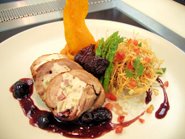
 Being winter now in Europe, I urge N to go for the Boned Stuffed Quail with Prunes which turn out to be a great option. The bacon wrapped bird was roasted to the right doneness and went very well with the dried prune compote and gelatinous rich demi glace. Against the sweet prunes, each morsel of salty wrapped bacon quail tasted simply divine!


 Good strawberries?
 Size does matter
 Some of the classic dishes that we eat today have long been prepared with certain ingredients not only for taste and flavour reasons but food safety too. Some ingredients are able to help in holding prepared foods for a few days while others may allow longer periods of preservation in terms of months. Preservation with various types of ingredients can result in salty, spicy, sweet or sour taste sensations in the kind of foods we eat so it is up to the creative expertise of the chef to balance out taste on the palatte.


 One of the most heart wrenching things that is happening right now in Singapore are the exodus of good chefs that have chosen to leave this tiny red dot on the global map for greener pastures overseas. While we should be proud that our local chefs are making their mark overseas, what Singapore has lost is what the rest of the world especially China has gained. In the last ten years, we have lost prominent culinary talents like Justin Quek, the Aw Yong brothers, Jack and Martin, Eric Chiam, Jason Ong, Eric Ong, Jereme Leung, Kidd Leong, all which are home grown talents that have chosen to move beyond our shores. As the Chinese saying goes, “Bu shi Meng Long Bu Guo Jiang” or translated literally it means “only fierce and brave dragons will cross the mighty river”, the consolation is that we have people overseas whom we can be proud of as they showcase in their daily course of work, the mighty culinary prowess of this little island on the southernmost tip of continental Asia.
 Very kindly, we were given a table that allowed us to enjoy a panoramic view of the Bund as we dine.
 Here at the Whampoa Club, Chef Jereme has given this classic dish a modern twist which should just aptly rename the dish as Drunken Chicken with Shaoxing Wine Granita. Using the idea of
 Autumn is the season for Hairy Crabs those from Yang Teng Lake are reputed to be the best. Unlike the regular mud crab or Sri Lanka crab that is often appreciated for its chunky pieces of meat, these hairy crabs are highly sought after for a different aspect. While each crab does not yield as much meat as other varieties, it is the taste of its natural sweetness, extra creamy rich roe and fine textured meat that many diners go after for. Our crab oriented starter (Stir Fried Crabmeat with Edomame and Shimeji Mushrooms salad and Vinegar Pearls) came in three components. First there was a fine salad of fresh green soya beans, honshimeiji mushrooms and frisee. The crabmeat was cooked in a superior stock and came as a shot in tequila glass accompanied with a few delicate pearls of black vinegar on the side. The idea is to pour the crabmeat over the salad and add on the vinegar pearls, toss the salad gently and allow the pearls to melt in the warmth of the crabmeat. This creates a simple vinaigrette which dresses the whole salad that is greatly enhanced by the sweetness of the fine textured crabmeat. Very innovative, very seductive!

 N’s soup was a puree of pumpkin cooked in a flavourful stock. While most “Tang Yuan” or glutinous rice balls are often served as desserts with sweet fillings, Chef Jereme has chosen to have it done the savoury way filled with delicious crabmeat extracted from the hairly crabs in season. The result is a slightly sweet pumpkin soup that was well contrasted by the burst of savoury crab filling when u bite into it. Personal, I wished for a sprinkle of crispy fried prosciutto into the soup and the salty ham would have lift the body of the soup to that with a more umami character.
 The plum juicy lightly battered king prawns were coated with a wasabi flavoured mayonnaise that delivered that right punch of pungency. Accompanying the prawns was a fruit kebab of dragon fruit, mango and Watermelon that cleanses the palate as you move on to the ribs.
  The meaty ribs were coated in a bitter sweet sauce of dark chocolate, hints of mocha and spices. Flakes of roasted almonds were sprinkle on as garnish but the nuts actually help to bridge the taste of the sauce and meat together.
 A lighter way to cook the Shanghainese favourite fish , “Gui Yu” or Mandarin Fish as it is also commonly known locally is to gentle poach it and serve with a wine lees flavoured sauce. This lovely sauce put together with black fungus and bamboo shoots, has the sweet winey notes from the use of the wine lees as a key ingredient and its gentle lightness compliments the delicate thinly sliced poached fish fillets very well. A topping of finely shredded deep fried dried scallops balanced out the sweetness of the sauce with its umami and crispy character, uplifting the dish with a touch of finesse and sophistication.
 As in many traditional Chinese way of menu progression, we closed the savoury part of the menu with crispy noodles braised with fresh river shrimp and soya sauce jelly. The idea is to toss up the noodles with the soya sauce jelly allowing the fermented bean flavour of the soy sauce to be release into the noodles as the jelly melts. This prevents the loss of delicate aromas of the soya sauce which is often evaporated off by excessive heat during cooking if it were to be braised together with the noodles. The fine noodles were also a pleasurable experience on the palate as they soak up the delicious braising sauce.
 N was mentioning as the service staff reset our table that they seemed to know what dessert we were going to choose and as soon as she just finished on that, a complimentary dessert tasting platter was place before us and even Chef Hew popped by to say hello. This is indeed a much needed break from traditional Chinese restaurant culture where most of the times, the chefs hide in the kitchens and are often too shy to come out to interact with customers. Well, this could also be a chef to chef kind of camaraderie since I had already made my profession known in the email booking, but is always an honour to have chefs dinning in your restaurant more so if they had come all the way from overseas. I would feel the same way too if someday when I do own a restaurant and having the support of fellow chefs from everywhere. We truly appreciate the







.jpg)